
Challenging Problems in Geometry: Problem 4-36
/ 6 min read
Table of Contents
Problem 4-36
The following is a problem that appears in Challenging Problems in Geometry by Alfred S. Posamentier and Charles T. Salkind:
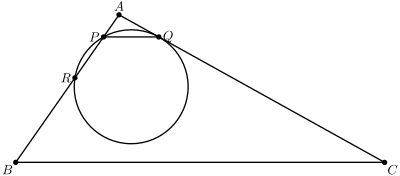
A line, , parallel to base of , cuts and at and , respectively. The circle passing through and tangent to at cuts again at . Prove that the points , , , and lie on a circle.
Solution
The “book” solution is pretty fast and involves showing angle is supplementary to angle . However, Curzon came up with a slightly longer alternate proof today that involved showing the other pair of opposite angles are supplementary. I thought it was creative enough for a 9 year old that I’d write it here for posterity. And yes, I do realize that it’s essentially re-proving the Tangent-Chord Angle Theorem using facts about cyclic quadrilaterals :)
Curzon Solution
The key idea is to reflect point across the circle to form diameter . Then connect and :
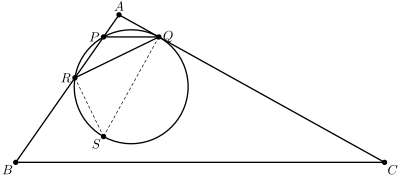
Now call angle and do some basic angle chasing:
- because is a transversal through parallel lines and
- because they’re supplementary
- because is cyclic and opposite angles are supplementary
- because of inscribed angle theorem
- because angles in triangle add to
- because a radius (or diameter) makes a right angle with tangent lines
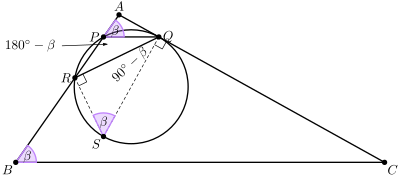
Lastly, , which is the supplement of .