
Learning Cross+1 on the Rubik's Cube
/ 8 min read
Table of Contents
Curzon recently got back into cubing, so I thought I’d do the same. Once upon a time I could get 13.xx average of 12s, but after a few years without practice I’ve slowed down a bit. My most recent average of 50 clocked in at 15.93s.
What’s the lowest hanging fruit to get faster? On acubemy.com, you can compare your splits with other solvers at different skill levels. Comparing my splits to other cubers that average 12s, it was clear what my problem was: F2L. While my last layer was actually comparable, my average time to complete the F2L stage was literally 3.5s slower!
After digging around, I decided it’s finally time to practice cross+1.
Starting Point
Here’s my self-assessed skillset going into this training:
- I am a fixed color cross solver (blue).
- I use 0% of my inspection time doing anything other than planning the cross.
- I’m near-perfect at finding optimal cross solutions when they are 4 or 5 move crosses. For 6 move crosses I estimate I’m somewhere around 60% or 70% (about a third of the time I will use 7 moves to solve a 6-mover). For 7 move crosses I believe I rarely ever find the optimal solution, oftentimes requiring 9 moves.
- I have very little understanding of how solving certain pieces into place impacts other pieces.
The Training Loop
Following everybody’s suggestions online, the idea is to practice untimed cross+1. Here’s what I want the loop to look like:
- Scramble my smart cube.
- Take as much time as I need to inspect and find a cross+1 solution.
- Close my eyes and perform my solution.
- Check to see if I was correct. If yes, go back to Step 1. If not, go to Step 5.
- Click Retry and go back to Step 2. (Note that if I have to retry a solve, it’s a DNF even if I correctly solve it after some number of retries).
To facilitate this, I built a site that interacts with a smart cube and provides rapid-fire training. It looks like this:
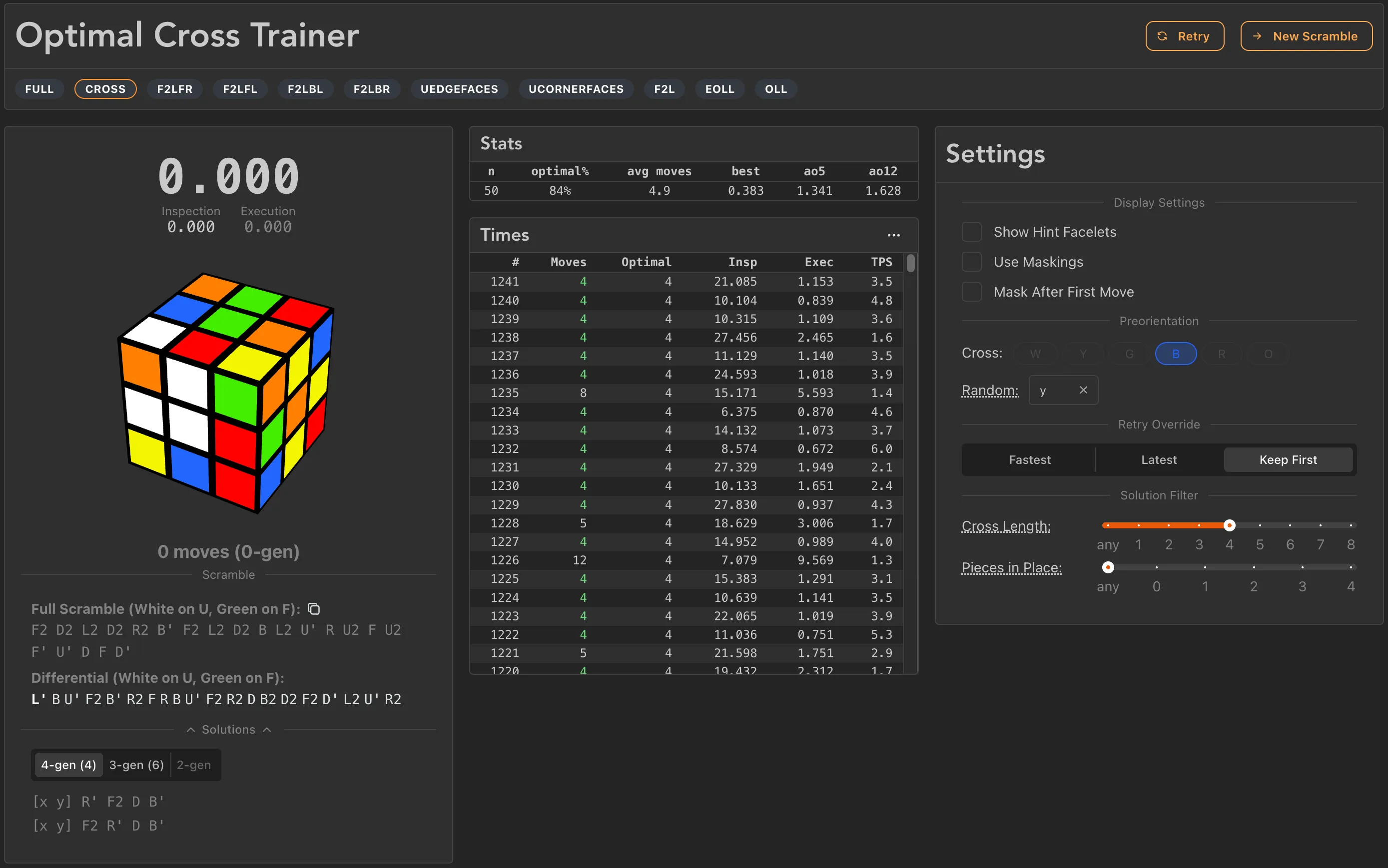
It’s not really production ready, but you’re welcome to poke around: naimoli.com/cubetrainer/
Basically I set it to “Blue” cross, pick the optimal cross solution length, and let it generate scrambles for me. One important feature that I made that I don’t think other trainers do well is that I also offer a “differential scramble”, which is a sequence of moves to get from whatever configuration the cube happens to be in to the desired fully scrambled state. In other words, at any point in time I can do “New Scramble” and get to the next state quickly without needing to solve the cube first. Or, if I make a mistake, I can “Retry” and get back (again without requiring a full solve). This saves a tremendous amount of time and really helps me to isolate this skill.
2-Movers and 3-Movers
I started out generating 2-move crosses. This proved to be a little too easy and I was able to figure out the cross and the next F2L pair too routinely and easily in under 15s inspection time. I upped it to 3-move crosses and it was similar, although slightly more challenging. I think I was averaging about 10s to come up with the solution, although I don’t really have this data anymore because it didn’t feel important. Time to up the difficulty.
4-Movers
This is where I spent most of my last few days. At 4 moves, I had many DNFs and was almost never able to see a solution in under 15s. It was a massive increase in difficulty for me. For the first 200 solves it almost literally hurt my brain trying to track what was happening. But fast forward a few hundred solves and it started to feel almost natural. I think the graph you’ve all been waiting for is this:
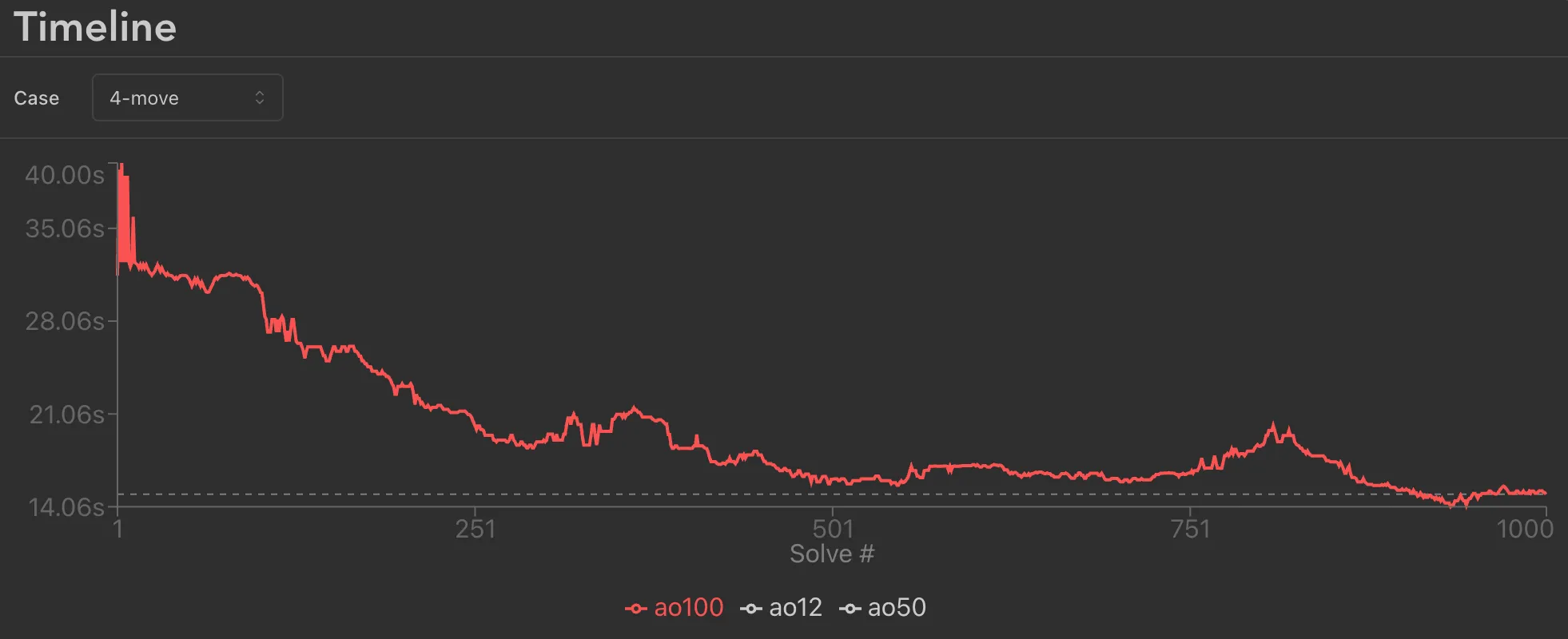
After 1000 solves, my average inspection time finally dropped below 15s (the dotted line on the graph). Doing a couple hours a day, this took approximately one week. Also what’s not visible in this graph is my DNF rate. I don’t have this handy but I estimate my DNF rate went from 70% in the beginning to maybe 10% at the end.
Main Takeaways
This is maybe the most important section. Hopefully this will help someone.
-
Ignore edges and only track a corner that will end up on the U layer. This was BY FAR the hardest part in the beginning. I simply had no intuition on which corners would end up where and I would often track a corner move by move only for it to trap itself on some awful slot on the D layer. Truth be told, my worst times right now are still the cases where 3 corners are on the D layer and it isn’t obvious to me which corner will be the lucky one to end up on top. All I can say is that it gets easier and to never settle for a trapped corner.
-
Once you’ve found a corner that ends up on top, commit to that pair as your first pair. Now locate its edge and figure out where that goes. It’s not as important (to me) that the edge ends up on the top layer since I know a bunch of 5-move inserts with trapped edges and at worst I can liberate them and insert in 7 moves from most angles.
-
I only pay attention to where the D face of the corner is facing and the EO of the edge at the end of my cross. I don’t actually pay much attention to the sticker colors. From the EO of the edge and their relative placement I know which F2L case it’s going to be. I don’t know if this is what other people do.
-
You’ll quickly realize that there are a lot of “tricks” you can do:
- You’ll start to see more xcrosses.
- Use keyhole at the end of your cross if you notice an edge or corner will end up solved.
- Alter your cross solution slightly to make tracking easier or to preserve a free pair.
- Solve your cross in a way that your first F2L pair solves into the back (this is currently the most impactful to my solves).
While I think these tricks are really fun and I like playing around with them, I still think the most important part at this phase is to just pick a cross solution, whatever that might be, and track a pair whose corner ends up on top. I’m pretty sure once this becomes easy to do, these additional optimizations will come second nature.
Conclusion
To be clear, I don’t think this progression is particularly impressive. I’m 40 years old and my neuroplasticity simply isn’t what it used to be. I suspect a smart kid’s learning curve would put this to shame.
The main reason I wrote this post is because I didn’t see anybody else’s progression statistics online regarding cross+1. It always seemed a little mysterious and outside my comfort zone, and so I never even tried to practice it. Hopefully this will give some baseline encouragement to others out there so they can see a light at the end of the tunnel for cross+1.
Next steps are to either keep drilling this to get my 4-mover average cross+1 to below 10s inspection, or to increase my training scrambles to 5-movers. I haven’t decided yet. That may be a future blog post itself.