
JHMT 2021 Geometry Problem 6
/ 3 min read
Table of Contents
2021 JHMT Geometry Problem 6
JHMT is a convex quadrilateral with perimeter and satisfies , , and . Furthermore, ray bisects . Compute the length of .
Diagram
There’s no diagram given in this problem, so our first step is to make our own. This was my first pass (digitized from paper, not to scale):
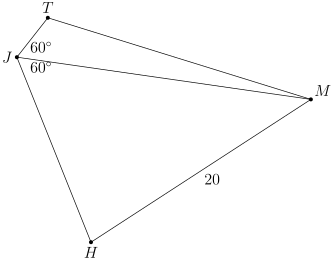
It seemed like JT needed to look fairly “small” in order for , so this is how I decided to visualize it.
Construction
I’m reminded of some advice I saw in Carl Joshua Quines’ excellent handout Constructions1.
If you have a condition like , you almost always want to “unroll” or “open the gates”.
The first is constructive: turning the sum of two segments into a single segment. If appears on one side, construct a point on ray such that . Then , and will hopefully form an isosceles triangle, parallelogram, isosceles trapezoid, or cyclic quadrilateral.
Note that you can try constructing on ray instead. Constructing in the opposite direction sometimes helps as well.
This problem follows that advice perfectly. Start by extending ray to the point such that :
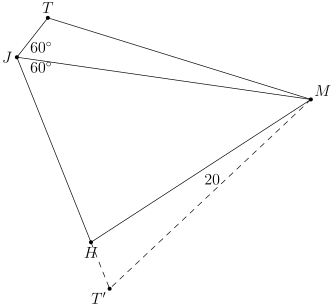
Beautiful! Not only is isoceles, it’s equilateral since the vertex angle is . From this we know three pieces of information:
- ,
- , and
- .
By SAS, ! This congruence gives us the critical fact that . Since the perimeter of the whole quadrilateral is and two of the sides are , the remaining segments and must add up to . But we’re given that is the sum of those two segments so our final answer is .
Alternative Construction
Try rotating the entire diagram CCW around point .