
Tournament of Towns 2019 Spring Senior O #1
/ 6 min read
Table of Contents
Tournament of Towns, Senior O-Level Paper, Spring 2019, Problem 1
The distances from a certain point inside a regular hexagon to three of its consecutive vertices are equal to , , and , respectively. Determine the length of this hexagon’s side.
- Mikhail Evdokimov
Solution
I get excited when I see a problem where the ancient and forgotten College Geometry toolkit actually applies. The key here is to ignore the actual distances until the end and focus on the ratios.
Let the point be , and let the three consecutive vertices be , , and . Start with a regular hexagon of unknown side length . We’ll scale it later.
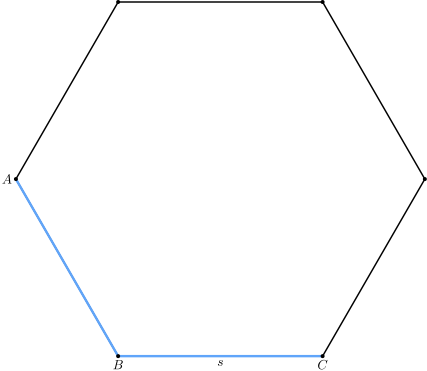
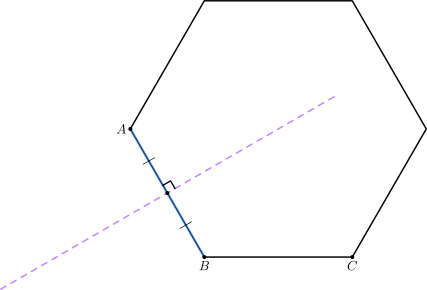
Now start incorporating the constraints. The first constraint is not really that , but just that is equidistant from and . In other words, lies on the perpendicular bisector of .
The condition involving is a ratio condition:
The locus of points satisfying that ratio is the Apollonius circle of , centered on line a distance from on the far side of , with radius . The point we want is the intersection of this circle with the perpendicular bisector of that lies inside the hexagon.
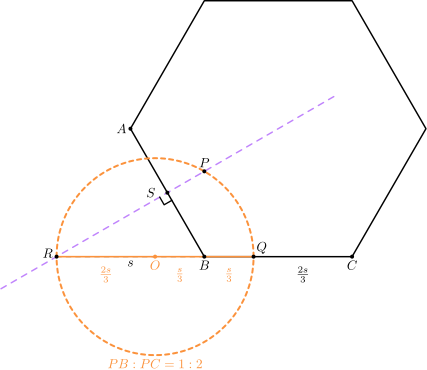
Note that it is not immediately obvious that , line , and the circle centered at all meet at .
Here is why that works. The point is on line , and the diagram gives . Since and , is equilateral. Thus the median from to the midpoint of is also an altitude, so is the perpendicular bisector of . Therefore , , and are collinear.
Also, is a diameter of the Apollonius circle, so . Since is a -- triangle, . Therefore .
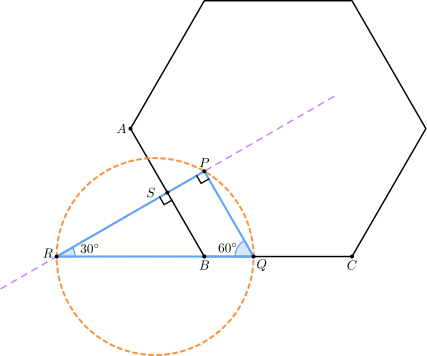
Now consider :
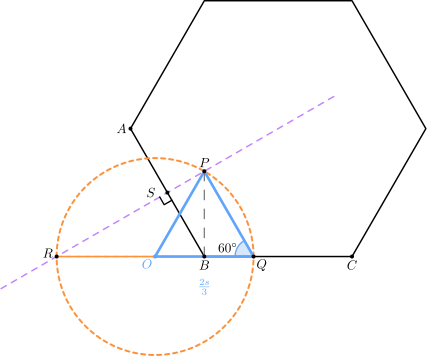
Since and are radii, is isosceles. But , so is actually equilateral.
Finally, is the midpoint of , so is an altitude of equilateral . The side length of this equilateral triangle is
so
Since the problem requires , we get