
Euclidea Chord Trisection
/ 17 min read
Updated:Table of Contents
Euclidea
Merry Christmas! Curzon and I have been working through Euclidea problems. For those unfamiliar, Euclidea is a geometric construction puzzle game where you solve problems using only compass and straightedge, trying to minimize the number of moves.
We’ve been making good progress through the packs, but recently hit a wall on the Chord Trisection problem in the Kappa pack.
Problem 10.8 (Kappa)
Construct a chord of the larger circle through the given point that is divided into three equal segments by the smaller concentric circle.
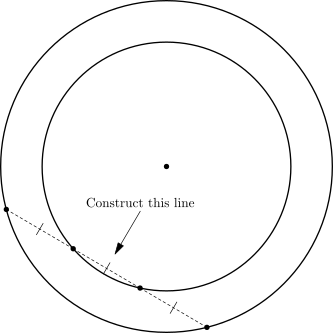
The Search for Optimality
We were able to find a solution that worked using a brute-force power-of-a-point approach, which earned us the basic completion star. However, Euclidea gives you bonus stars for finding the optimal solutions, and we were completely stumped.
For each problem there are two independent optimal solutions. One is measured based on the number of “L” moves you make, the other based on the number of “E” moves. This particular problem’s optimal solutions are listed as 3L and 4E:
- 3L = 3 Lines/tools (including advanced constructions like perpendicular bisectors, angle bisectors, parallel lines, and perpendiculars, which each count as 1L but might require 3-4 elementary steps to construct)
- 4E = 4 Elementary steps (using only basic constructions: points, lines, and circles)
These seemed impossibly efficient compared to our approach. After much head-scratching, we finally caved and checked the Euclidea Wiki.
The 4E Solution
Here are the construction steps:
- Construct line , intersecting the smaller circle at (closer to ) and the larger circle at
- Construct circle with radius
- Let this circle intersect line at
- Construct circle with radius , intersecting smaller circle at
- Construct line - this is your trisected chord!
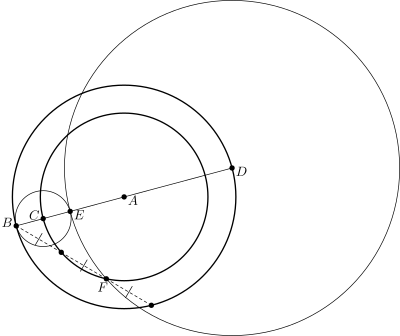
Extremely efficient. There’s just one question: Why does this work? Let’s just check the Explanation section…

Huh, empty. Well, let’s see if we can figure out why!
Proof (Old)
For the duration of this proof, let:
- = radius of the inner circle
- = radius of the outer circle
The key insight is to introduce an auxiliary point , which is the reflection of point across the circle center , creating diameter :
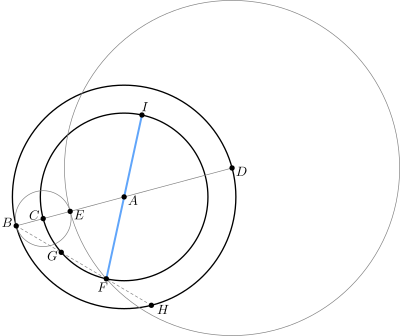
Also observe that we only need to prove . Trisection follows since it should be obvious from the symmetry of the problem that is always congruent to since the circles are concentric.
Step 1: Congruent Triangles
Connect and . We claim that :
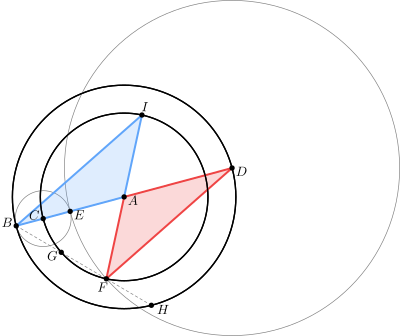
These triangles are congruent by SAS:
- (both are radii of the inner circle, since and are reflections across )
- (both are radii of the outer circle)
- (vertical angles)
Therefore , which means .
Step 2: The Radius of Circle D
By construction, circle has radius . This could be demonstrated rigorously by comparing all of the segments along segment , but it should be pretty obvious that the purpose of circle is to provide point a distance on the other side of point .
Step 3: Isosceles Triangle
From Step 1, we have , and from Step 2, we have (the diameter of the inner circle). But is also a diameter of the inner circle. Therefore , which means is isosceles!
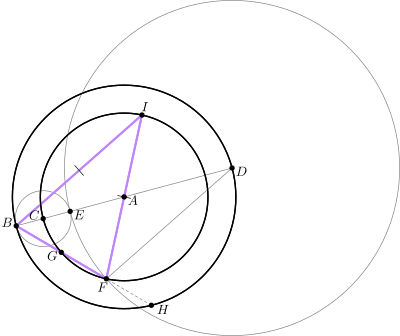
Step 4: IG is a Median
Points , , and are concyclic on the inner circle. Since is a diameter, by the inscribed angle theorem, :
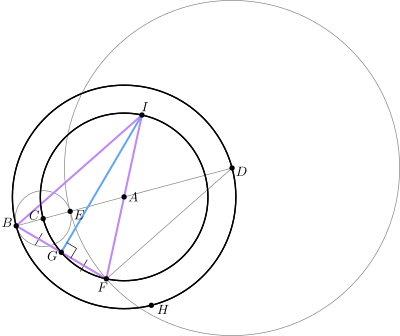
Therefore , so is an altitude of triangle . Since triangle is isosceles with (from Step 3), altitudes are also medians. Therefore is the midpoint of , giving us .
Proof (New: AlphaGeometry)
After writing the proof above, I decided to see if AlphaGeometry could solve this problem. Here’s the JGEX setup I used:
euclidea_trisectiona b = segment a b; c = on_line c a b; e = mirror e b c; d = mirror d b a; f = on_circle f d e, on_circle f a c; g = on_line g b f, on_circle g a c; h = on_line h b f, on_circle h a b ? cong f h f gAwesomely, AlphaGeometry was able to prove this without requiring any auxiliary points! My original proof relied on introducing point (the reflection of across center ), but AlphaGeometry’s DDAR (Deductive Database and Angle Reasoning) engine found a direct proof using only the points from the construction itself.
Here’s what AlphaGeometry spit out:
========================== * From theorem premises:A B C E D F G H : PointsCB = CE [00]AB = AD [01]B,D,A are collinear [02]AF = AC [03]DF = DE [04]AG = AC [05]B,F,G are collinear [06]B,F,H are collinear [07]AH = AB [08]
 * Auxiliary Constructions:: Points

 * Proof steps:001. AG = AC [05] & AF = AC [03] ⇒  AF = AG [09]002. AF = AG [09] ⇒  ∠AFG = ∠FGA [10]003. CB = CE [00] & AB = AD [01] (Distance chase)⇒  ED:CA = 2_/1 [11]004. AB = AD [01] (Distance chase)⇒  BA:BD = 1_/2 [12]005. ED:CA = 2_/1 [11] & BA:BD = 1_/2 [12] & AH = AB [08] & FD = ED [04] & FA = CA [03] ⇒  BD:BA = FD:FA [13]006. BD:BA = FD:FA [13] & B,D,A are collinear [02] ⇒  ∠DFB = ∠BFA [14]007. H,B,F are collinear [07] & ∠AFG = ∠FGA [10] & B,F,G are collinear [06] & ∠DFB = ∠BFA [14] ⇒  ∠(FD-HB) = ∠(GA-HB) [15]008. ∠(FD-HB) = ∠(GA-HB) [15] ⇒  FD ∥ GA [16]009. DF ∥ AG [16] & B,F,G are collinear [06] & B,D,A are collinear [02] ⇒  AB:AD = GB:GF [17]010. AH = AB [08] ⇒  ∠AHB = ∠HBA [18]011. H,F,B are collinear [07] & B,F,G are collinear [06] & ∠AHB = ∠HBA [18] ⇒  ∠AHF = ∠GBA [19]012. H,F,B are collinear [07] & B,F,G are collinear [06] & ∠AFG = ∠FGA [10] ⇒  ∠AFH = ∠BGA [20]013. ∠AHF = ∠GBA [19] & ∠AFH = ∠BGA [20] (Similar Triangles)⇒  HA:BA = HF:BG [21]014. AB:AD = GB:GF [17] & AB = AD [01] & HA:BA = HF:BG [21] & AH = AB [08] ⇒  FH = FG==========================
The key idea here is step 009, which I had missed in my solution. Connect D to F and A to G:
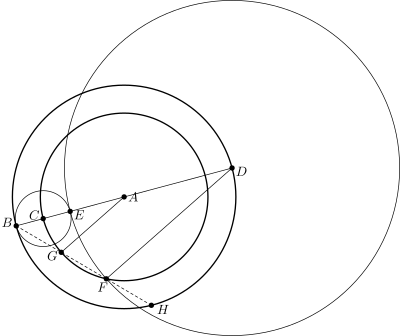
AlphaGeometry found some similar triangles, and . Why are they similar? The forbidden ASS (Angle-Side-Side) similarity. They share the common angle at B, and . And crucially, angles and are guaranteed to be acute because is a central angle that is less than by construction, and inscribes an arc that’s strictly less than a semicircle. Since they are similar with a scale factor of , is exactly half of and we’re done! Pretty smooth.