
Inscribing a Square in a Triangle
/ 51 min read
Table of Contents
Today I want to talk about a cool construction and how it’s actually used in contest math. Stick around (or skip) to the end for a cool problem.
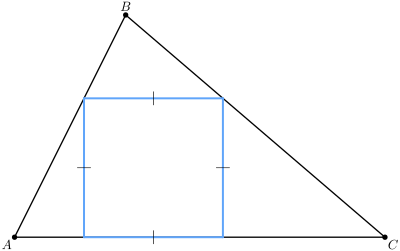
Euclidea Problem 13.4 (Nu) - Square in Triangle
Given triangle , inscribe a square such that two vertices lie on side and the other two vertices lie on sides and .
The 6L Solution
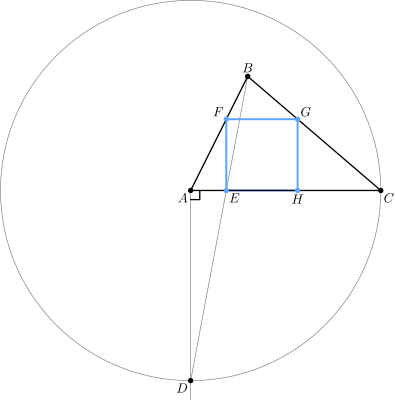
Why does this work? This is a homothety-based construction. We start with a large square and progressively shrink it until it inscribes the triangle. Here’s a visualization of this transformation:
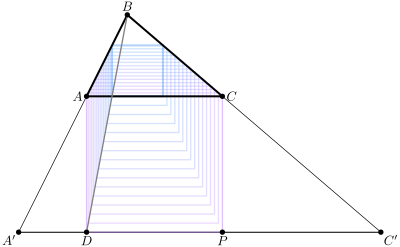
We start with square inscribed in the larger similar triangle. As we perform a homothety centered at to shrink the triangle down to , the lower left corner of the square remains on line because homotheties preserve collinearity through the center.
Cool construction, but how is this useful?
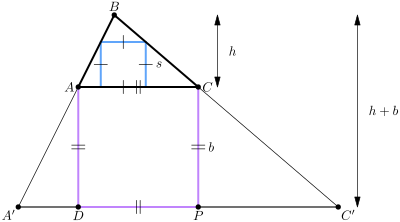
Side Length of Inscribed Square Formula
You could arrive at this formula by considering two pairs of similar triangles in the original figure, but with this construction it’s immediate and intuitive. Since , corresponding sides are proportional:
See diagram below:
Application to Contest Math
2009 NYCIML Fall Senior B #5
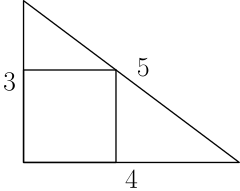
A square is inscribed in a 3-4-5 right triangle as shown in the diagram. Find the area of the square.
2007 MathCounts State Sprint #30
Right triangle has one leg of length 6 cm, one leg of length 8 cm and a right angle at . A square has one side on the hypotenuse of triangle and a vertex on each of the two legs of triangle . What is the length of one side of the square? Express your answer as a common fraction.
2023 MAΘ Alpha Ciphering #9
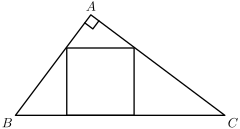
A square is inscribed in an isosceles triangle, with one of its sides on the triangle’s base. The length of the base of the triangle is 10 and its legs have length of 13. What is the side length of the square?
2005 MathCounts National Target #4
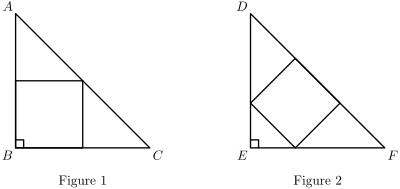
Triangle and triangle are congruent, isosceles right triangles. The square inscribed in triangle has an area of 15 square centimeters. What is the area of the square inscribed in triangle ? Express your answer as a common fraction.
2005 JHMT Geometry #8
The square is constructed inside the -- triangle , with the hypotenuse , on side , on side , and on side . What is the side length of the square?
1987 AHSME #21
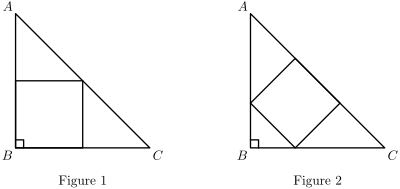
There are two natural ways to inscribe a square in a given isosceles right triangle. If it is done as in Figure 1 below, then one finds that the area of the square is . What is the area (in ) of the square inscribed in the same as shown in Figure 2 below?
(A) 378 (B) 392 (C) 400 (D) 441 (E) 484
2000 NYCIML Fall Senior A #16
The sides of a triangle are 13, 14, and 15. A square is inscribed in the triangle so that two of its vertices are on side 14. Compute the length of one side of the square.
2006 NYCIML Spring Senior A #9
A square, with side of length , is inscribed in an equilateral triangle, with side of length , such that two vertices of the square are on one side of the triangle. The other vertices are on the remaining two sides. The ratio may be written as . Compute .
1985 NYSML Team #10
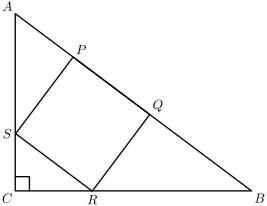
In right triangle , . Square is inscribed as shown. Let and the altitude from to be . If , compute the length of a side of the square.
1989 VTRMC #1
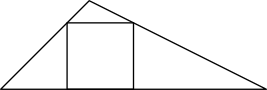
A square of side is inscribed in a triangle of base and height as shown. Prove that the area of the square cannot exceed one-half the area of the triangle.
Tournament of Towns, Senior O-Level Paper, Spring 2024, Problem 2
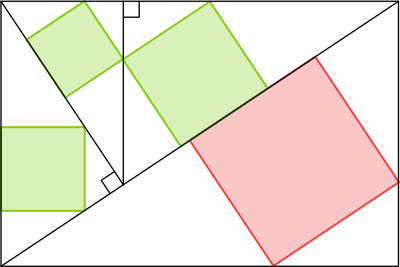
An arbitrary rectangle is split into right triangles as shown in the figure below. Into every right triangle, a square is inscribed with its side lying on the hypotenuse. What is greater: the area of the largest square or the sum of the areas of the remaining three squares? - Mikhail Evdokimov
Solution
This problem is pretty cool. For some intuition, consider the special case where the rectangle is actually a square. From the 1989 VTRMC #1 problem above, we know that the inscribed square’s area is exactly half its triangle’s area. This suggests the answer might be a trick question: the areas are exactly equal.
How do we prove this for an arbitrary rectangle? The key insight is to show that whenever you split a right triangle into two smaller triangles by dropping an altitude to the hypotenuse, the sum of the inscribed square areas in the two smaller triangles equals the inscribed square area in the original triangle. Looking at our diagram, we can see how the three lime squares come from recursively splitting: first, split the large red triangle to get the left lime square and an upper triangle. Then split that upper triangle again to get the final two lime squares:

The key insight is that when an altitude is dropped to the hypotenuse of a right triangle, it creates two smaller triangles that are similar to each other and to the original. Using this similarity along with the Pythagorean theorem and the relationship between hypotenuse and inscribed square side length gives a straightforward proof.
However, we’re going to prove something a little stronger and we’re going to do it using only synthetic geometry!
Synthetic Geometry Proof
Somewhat incredibly, not only do the areas sum to be equal but the vertices of the squares also meet up to form a perfect Pythagorean Theorem-esque formation:
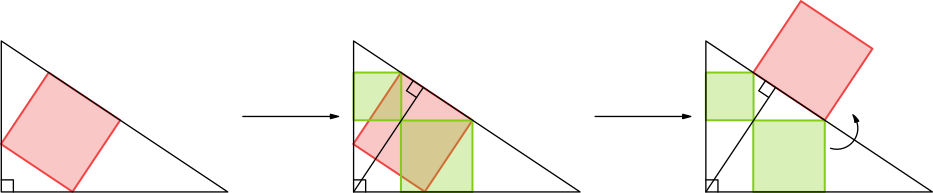
We’ll prove this in two steps:
- The vertices of the red square are coincident with the vertices of the green square along the original hypotenuse, and
- The vertices of the green squares on the altitude are also coincident.
This will also trivially yield the result that the areas are equal because of the Pythagorean Theorem.
Red Square Vertices Coincide with Green Square Vertices
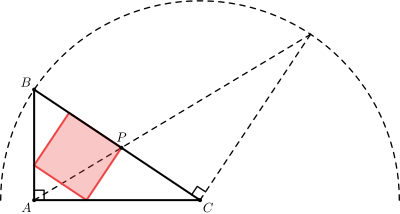
Consider right triangle with the right angle at . Using the construction from the Side Length of Inscribed Square Formula section, we construct the red square inscribed on hypotenuse . We draw a perpendicular to at , then a circle centered at with radius . The intersection of the perpendicular and the circle gives us a point, and the line from through this point intersects at vertex of the square.
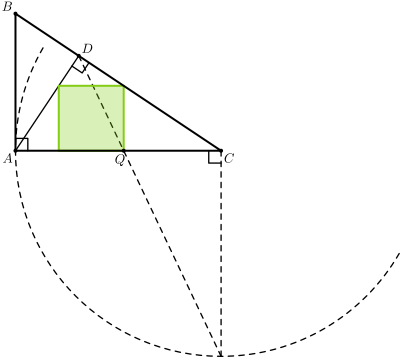
Now we construct the green square on hypotenuse using the same method. We also need the altitude from to , meeting it at point :
Now here’s both constructions overlaid:
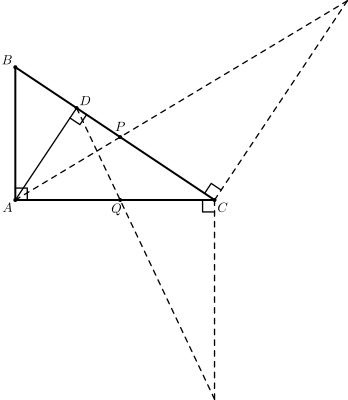
Remember we’re trying to show that the red and green squares coincide at point on hypotenuse . To prove this, it suffices to show that is perpendicular to .
First observe that since is similar to , their constructions are similar because we performed identical operations that preserve similarity. Thus :
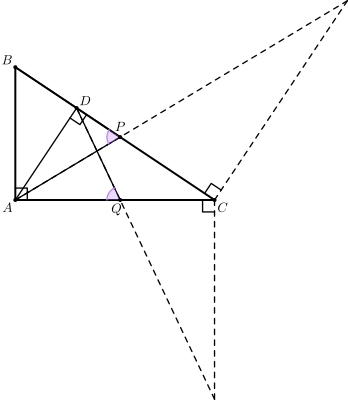
Consider the circumcircle of . Since and both angles inscribe the same arc of the circumcircle, by the converse of the inscribed angle theorem, also lies on that same circle. Thus is a cyclic quadrilateral and opposite angles are supplementary. Since is a right angle, so is . Therefore , which means the red and green squares meet at :
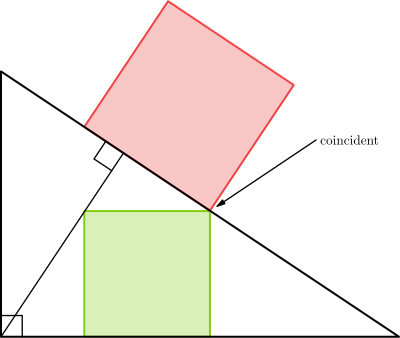
But there was nothing special about which sub-triangle we chose. Repeating the identical proof on the other side gives us:
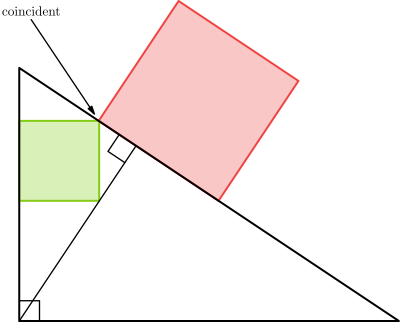
It sort of looks like we could be done here, except we haven’t shown that something like this isn’t happening:
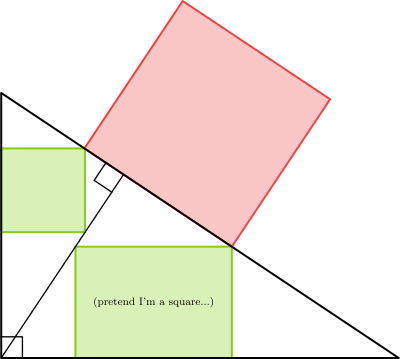
Let’s prove that can’t happen.
Green Square Vertex Coincides with Other Green Square Vertex
This is basically the same idea as above, but we perform the constructions on the two sub-triangles:
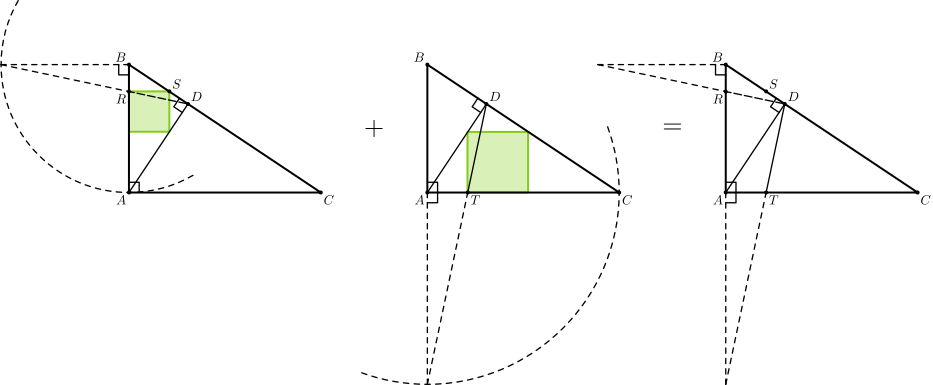
Remember we’re trying to show that the two green squares coincide at a point on altitude . This is equivalent to showing that is perpendicular to .
Just like in the first proof, since and we’re performing identical constructions on each, the following two triangles are also similar:
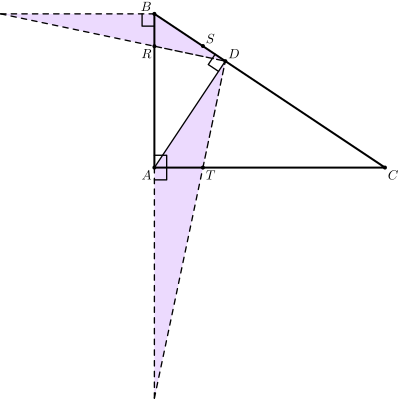
Since and , . is opposite and supplementary to , showing is a cyclic quadrilateral:
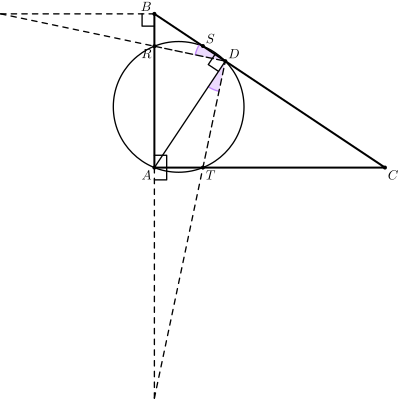
But point is also on that circle. Why? Because , quadrilateral is also cyclic (it has two opposite supplementary angles). So both and are on the circumcircle of ! This implies that is supplementary to , proving that .