
Altshiller-Court Ch 1: Geometric Constructions
/ 197 min read
Updated:Table of Contents
I just started reading Nathan Altshiller-Court’s College Geometry: An Introduction to the Modern Geometry of the Triangle and the Circle (1952). I’m intrigued by how different it is from every other geometry book I’ve read before. I’d write a full review, but I’m not finished yet! Until then, this page serves as a sort of journal. Periodically when I’m bored I go through some exercises. Although many are not so interesting or repetitive, I’ve already encountered techniques that are new to me.
For example, very early on there’s a problem that tasks you with constructing a triangle given (a side, the angle bisector to that side, and the ratio of the other two sides). Although the answer is short and simple, I’d never before had to construct an Apollonius circle.
So while I’ve no doubt that at some point I’ll abandon this journal and the problems will remain forever unsolved, in the meantime I’m adding the problems from Chapter 1 and entering solutions as I see fit. This also serves as an experimental page for creating interactive JSXGraph constructions!
Other Chapters
- Geometric Constructions
- Similitude and Homothecy
Chapter 1: Geometric Constructions
A. Preliminaries
Construct a triangle, given:
- .
- .
- .
- .
- .
- .
- .
Construct a right triangle, with its right angle at , given:
- .
- .
- .
- .
Construct a parallelogram , given:
- .
- .
- .
Construct a quadrilateral , given:
-
.
-
.
-
.
-
With a given radius to draw a circle tangent at a given point to a given (i) line; (ii) circle.
-
Through two given points to draw a circle (i) having a given radius; (ii) having its center on a given line.
-
To a given circle to draw a tangent having a given direction.
-
To divide a given segment internally and externally in the ratio of the squares of two given segments . (Hint. If is the perpendicular to the hypotenuse of the right triangle , .)
-
Construct a right triangle, given the hypotenuse and the ratio of the squares of the legs.
-
Given the segments , construct the segment so that .
-
Construct an equilateral triangle equivalent to a given triangle.
B. General Method of Solution of Construction Problems
-
Through a given point to draw a line making equal angles with the sides of a given angle.
-
Through a given point to draw a line so that two given parallel lines shall intercept on it a segment of given length.
-
Through one of the two points of intersection of two equal circles to draw two equal chords, one in each circle, forming a given angle.
-
Through a given point of a circle to draw a chord which shall be twice as long as the distance of this chord from the center of the circle.
-
On a produced diameter of a given circle to find a point such that the tangents drawn from it to this circle shall be equal to the radius of the circle.
-
With a given point as center to describe a circle which shall bisect a given circle, that is, the common chord shall be a diameter of the given circle.
-
Through two given points to draw a circle so that its common chord with a given circle shall be parallel to a given line.
-
Construct a parallelogram so that three of its sides shall have for midpoints three given points.
-
On a given leg of a right triangle to find a point equidistant from the hypotenuse and from the vertex of the right angle.
-
With two given points as centers to draw equal circles so that one of their common tangents shall (i) pass through a (third) given point; (ii) be tangent to a given circle.
-
Through a given point to draw a line so that the two chords intercepted on it by two given equal circles shall be equal.
-
To a given circle, located between two parallel lines, to draw a tangent so that the segment intercepted on it by the given parallels shall have a given length.
-
Construct a right triangle given the hypotenuse and the distance from the middle point of the hypotenuse to one leg.
-
Construct a triangle given an altitude and the circumradii (i.e., the radii of the circumscribed circles) of the two triangles into which this altitude divides the required triangle.
C. Geometric Loci
-
A variable parallel to the base of a triangle meets , in , . Show that the locus of the point is a straight line.
-
On the sides , of a triangle are laid off two equal segments , of variable length. The perpendiculars to , at , meet in . Show that the locus of the point is a straight line. Find the locus of the projection of upon the line .
-
Find the locus of a point at which two consecutive segments , of the same straight line subtend equal angles.
-
The base of a variable triangle is fixed, and the sum is constant. The line drawn through the midpoint of parallel to meets the parallel through to the internal bisector of the angle , in . Show that the locus of is a circle having for center.
Construct a triangle, given:
- .
- .
- .
- .
- .
- . (Peter’s note: this is Euclidea 13.10 Nu: Billiards on Round Table.)
Construct a parallelogram, given:
- An altitude and the two diagonals.
- The two altitudes and an angle.
- The two altitudes and a diagonal.
- A side, an angle, and a diagonal.
- A side, the corresponding altitude, and the angle between the diagonals.
Construct a quadrilateral , given:
- The diagonal and the angles .
- The sides , the diagonal , and the angles .
- The sides , the angle , and the radius of the inscribed circle.
-
Construct a quadrilateral given three sides and the radius of the circumscribed circle. Give a discussion.
-
Given three points, to find a fourth point, in the same plane, such that its distances to the given points may have given ratios.
-
With a given radius to draw a circle so that it shall touch a given circle and have its center on a given line.
-
With a given radius to draw a circle so that it shall pass through a given point and the tangents drawn to this circle from another given point shall be of given length.
-
In a given circle to inscribe a right triangle so that each leg shall pass through a given point.
-
Construct a triangle given the base, the opposite angle, and the point in which the bisector of this angle meets the base.
-
Construct a triangle given the base and the angles which the median to the base makes with the other two sides.
-
About a given circle to circumscribe a triangle given a side and one of its adjacent angles, so that the vertex of this angle shall lie on a given line.
- Construct a triangle given the base, an adjacent angle, and the angle which the median issued from the vertex of this angle makes with the side opposite the vertex of this angle. (Peter’s note: this is similar to Euclidea 7.9 Eta: Segment by Midpoint.)
D. Indirect Elements
Construct a triangle, given:
Perimeter:
- .
- (or ).
Sum of two sides:
- (or ).
- .
- .
- .
- (or ).
- .
- .
- .
- . Hint. Construct . In the triangle we have the vertices , and a locus for . Lay off . The point lies also on the circle .
Difference of two sides:
- .
- .
- . Hint. Either or may be used as auxiliary triangle.
Sum of altitudes:
- .
- .
- .
- .
- . Hint. The triangle determines , and is thus known, hence the angles and may be constructed.
- .
Difference of altitudes:
- .
- .
- .
- .
Supplementary Exercises
- Through a given point to draw a circle tangent to two given parallel lines. (Peter’s note: for many more Apollonius-type problems and solutions, see Problem of Apollonius, a really cool website created by the students of PORG in the Czech Republic. This particular problem can be found here: Problem of Apollonius)
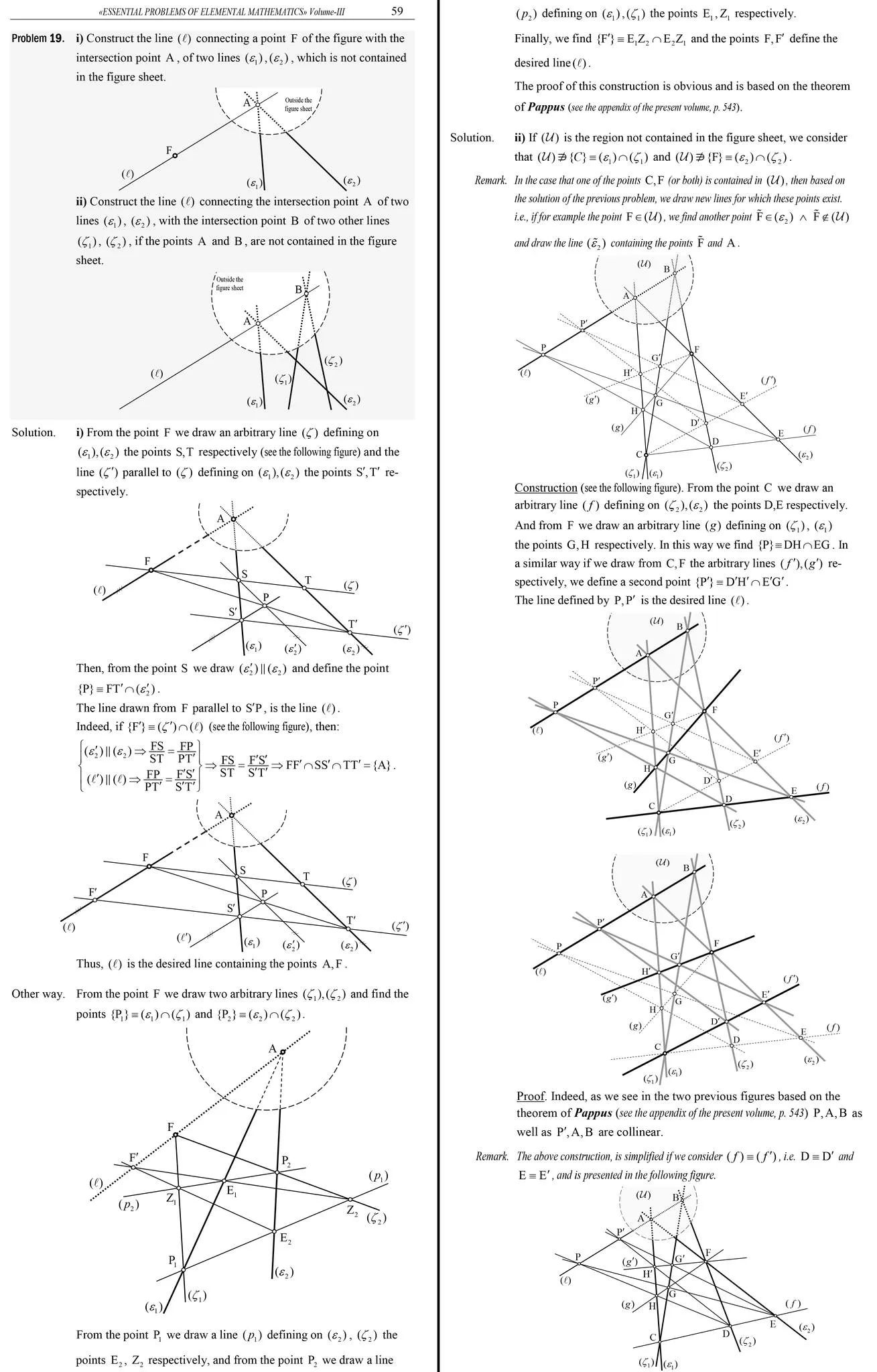
- Through a given point to draw a line passing through the inaccessible point of intersection of two given lines.
The above solution is my own. I found some other solutions that are easier to construct, but a little harder to understand:
- Draw a line of given direction meeting the sides , of a given triangle in the points such that .
- Through a given point to draw a line so that the sum (or the difference) of its distances from two given points shall be equal to a given length. Discuss two cases: when the two given points are to lie on the same side, and on opposite sides, of the required line.
Case (i): Two given points on opposite sides of the required line (sum of distances = d)
-
In a given equilateral triangle to inscribe another equilateral triangle, one of the vertices being given.
-
In a given square to inscribe another square, given one of the vertices.
-
On the side of a given parallelogram to find a point such that the angles and shall be equal.
- Construct a parallelogram so that two given points shall constitute one pair of its opposite vertices, and the other pair of vertices shall lie on a given circle.
- Through a point of intersection of two given circles to draw a line so that the two chords intercepted on it by the two circles shall (i) be equal; (ii) have a given ratio. (Peter’s note: this problem is covered later in the book on page 48, Ch. II §50.)
Case (i)
Case (ii)
The construction is the same as Case (i), except the tangent circle's radius should have the given ratio to the first circle's radius, rather than being equal.
- Through a point of intersection of two circles to draw a line so that the sum of the two chords intercepted on this line by the two circles shall be equal to a given length.
This one took me a while. It’s weirdly complicated with a bunch of edge cases. I don’t even know exactly how to prove this is true without trig.
- Through a point of intersection of two circles to draw a line so that the two chords determined on it by the two circles shall subtend equal angles at the respective centers.
- Given an angle and a point marked on one side, find a second point on this side which shall be equidistant from the first point and from the other side of the angle.
- With a given radius to describe a circle having its center on one side of a given angle and intercepting a chord of given length on the other side of this angle.
- With a given point as center to describe a circle which shall intercept on two given parallel lines two chords whose sum shall be equal to a given length.
- Draw a line parallel to the base of a given triangle and meeting the sides , in the points , so that the trapezoid shall have a given perimeter.
- Construct a triangle so that its sides shall pass through three given noncollinear points and shall be divided by these points internally in given ratios.
I was unable to solve this, but I found this really sleek solution by Paris Pamfilos.
Review Exercises
Constructions
- In a given circle to draw a diameter such that it shall subtend a given angle at a given point.
- Draw a line on which two given circles shall intercept chords of given lengths.
-
Place two given circles so that their common internal (or external) tangents shall form an angle of given magnitude.
-
Construct a right triangle given the altitude to the hypotenuse, two points on the hypotenuse, and a point on each of the two legs.
-
Through a given point of the altitude, extended, of a right triangle to draw a secant so that the segment intercepted on that secant by the sides of the right angle shall have its midpoint on the hypotenuse.
-
Through two given points, collinear with the center of a given circle, to draw two lines so that they shall intersect on the circle, and the chords which the circle intercepts on these lines shall be equal.
-
Through a given point to draw a line so that the segment intercepted on it by two given parallel lines shall subtend a given angle at another given point.
-
Construct a triangle given the base, an adjacent angle, and the trace, on the base, of the circumdiameter (i.e., the diameter of the circumscribed circle) passing through the opposite vertex.
-
Construct a triangle given, in position, the inscribed circle, the midpoint of the base, and a point on the external bisector of a base angle.
-
Construct a triangle given, in position, a line on which the base is to lie, a point of the circumcircle, a point of the side , the circumradius , and the length of the base .
-
In a given triangle to inscribe an equilateral triangle of given area.
-
With a given radius to draw a circle so that it shall pass through a given point and intercept on a given line a chord of given length.
-
Draw a circle tangent to two concentric circles and passing through a given point.
-
Construct a right triangle given the altitude to the hypotenuse and the distance of the vertex of the right angle from the trace on a leg of the internal bisector of the opposite acute angle.
-
Construct a rectangle so that one of its vertices shall coincide with a vertex of a given triangle and the remaining three vertices shall lie on the three circles having for diameters the sides of the triangle.
-
Construct a triangle given a median and the circumradii of the two triangles into which this median divides the required triangle.
-
Construct a triangle given , , .
-
On a given line to find a point such that if , are the tangents from to a given circle, we shall have angle .
-
On the sides , of the triangle to mark two points so that the line shall have a given direction and that , where is a given number (ratio).
-
Draw a line perpendicular to the base of a given triangle dividing the area of the triangle in the given ratio .
-
Through a given point to draw a line bisecting the area of a given triangle.
I was unable to solve this problem on my own. I did find a beautiful solution on Math Stack Exchange though.
-
Draw a line having a given direction so that the two segments intercepted on it by a given circle and by the sides of a given angle shall have a given ratio.
-
Through a vertex of a triangle to draw a line so that the product of its distances from the other two vertices shall have a given value, .
Explanation: This one is a little tricky. Consider . On the one hand because is the distance to our solution line - this is the obvious part. The harder part is why we make the purple circle at step 4. The key is that by making it a distance from , the power of any point on that circle relative to the big circle with radius will be . This is perfect because we want , which will be the case whenever is on that purple circle. Therefore, must lie on the intersection of these two loci.
-
Through two given points to draw two lines meeting a given line in the points so that , and so that the lines form a given angle.
-
Through a given point to draw a line cutting a given line in and a given circle in so that .
Apparently this problem is not even constructible with compass and straightedge! See this Math StackExchange discussion for details.
- With a given point as center to draw a circle so that two points determined by it on two given concentric circles shall be collinear with the center of these circles.
Type (i): Create a tangent to the circle of radius .
Type (ii): Create a tangent to the circle of radius .
- Inscribe a square in a given quadrilateral.
I spent quite a bit of time on this problem, enough that it probably deserves its own blog post. Unlike other exercises, I'll give a little bit more explanation for this one.
The inspiration comes from a much easier problem (not in this book): "In a given triangle, inscribe an equilateral triangle, one of the vertices being given." The way to solve this problem is to rotate the entire triangle 60° clockwise and counter-clockwise around the given vertex:
If that works for an equilateral triangle, perhaps it could work for a square? So let's try the same thing: rotate the entire quadrilateral 90° clockwise and counter-clockwise around a point on side :
It almost works, except there's nothing in this construction process to guarantee that the opposite vertex lies on the opposite side of the quadrilateral. Indeed, you can see in the above construction that points , , and look good but sort of just... floats there. It almost seemed like a dead end until I realized that the locus of point is actually a line! So all we need to do is find that locus and take its intersection with and that will be point ! Once we have point , we can perform the same 90 degree rotation trick to figure out where / and then should be:
A few interesting notes. The first is that this construction always succeeds as long as you allow the vertices of the square to be on the extensions of the sides of the quadrilateral. The second is this can be optimized by picking specific points and , not arbitrary points like I did. I only did it this way to illustrate that there's nothing really special about how you come up with the locus of points for since any two points on that line will define it.
I also spent quite a bit of time trying to find a better way to generate that line that sampling two of its points. In the end, I was unsuccessful after several ideas. Just for fun I'll share one such dead-end, which was to try to use the angles of the quadrilateral to arrive at the angle between the locus of and the line . I'll leave it as an exercise to the reader to see that this was not fruitful and that the formula is:
where and .
Propositions
-
The circle through the vertices of a parallelogram meets , in the points . Prove that .
-
Of the three lines joining the vertices of an equilateral triangle to a point on its circumcircle, one is equal to the sum of the other two.
-
Three parallel lines drawn through the vertices of a triangle meet the respectively opposite sides in the points . Show that: .
-
If the distance between two points is equal to the sum (or the difference) of the tangents from these points to a given circle, show that the line joining the two points is tangent to the circle.
-
Two parallel lines , through the vertices of the triangle meet a line through the vertex in the points . If the parallel through to meets in , show that is parallel to .
-
A variable chord of a given circle is parallel to a fixed diameter passing through a given point . Show that the sum of the squares of the distances of from the ends of is constant and equal to twice the square of the distance of from the midpoint of the arc .
-
The points divide the sides of the triangle internally in the same ratio, . Show that the three triangles are equivalent, and find the ratio of the areas .
-
The sides of the quadrilateral meet in , and the sides meet in . Along are measured off, respectively, equal to . Prove that is parallel to .
-
The point of a circle, center , is projected into upon a diameter . Along lay off . If meets the circle again in , prove that angle .
-
If is any point on a semicircle, diameter , and are two equal arcs, then if , prove that is perpendicular to .
-
In the triangle the side is smaller than and is a right angle. are two points on the hypotenuse such that angle . Show that the line joining to the midpoint of is tangent to the circle .
-
From the point the two tangents and the secant are drawn to the same circle. Prove that .
-
On the radius , produced, take any point and draw a tangent ; produce to , making , and draw a tangent ; if be drawn perpendicular to , meeting at , prove that .
-
The parallel to the side through the vertex of the triangle meets the tangent to the circumcircle of at in , and the parallel through to meets the tangent to at in . Prove that .
-
Two variable transversals determine on two fixed lines two segments of fixed lengths. If are two points on such that a constant ratio, prove that is fixed in magnitude and direction.
-
If are the projections of a point of the internal bisector of the angle of the triangle upon the sides , show that the perpendicular from upon meets in the point on the median of .
-
A circle touching at and passing through the incenter (i.e., the center of the inscribed circle) of the triangle meets in . Prove that bisects the angle .
-
are two chords of the same circle, and the lines joining to the midpoint of make equal angles with . Show that the lines joining to the midpoint of make equal angles with .
-
Three pairs of circles touch each other in . The lines meet the circle again in the points . Show that passes through the center of and is parallel to the line of centers of the circles and .
-
The mediators of the sides of the triangle meet the sides in . Prove that the points lie on a circle which passes through the circumcenter (i.e., the center of the circumscribed circle) of .
-
are two tangents to the same circle , and are perpendiculars to them respectively from the two given points . If , prove that the two tangents are parallel.
-
is a triangle inscribed in a circle; is the diameter bisecting at ; from a perpendicular is drawn to one of the sides, and the perpendicular from the vertex on meets in . Show that touches the circle .
-
If the internal bisector of an angle of a triangle is equal to one of the including sides, show that the projection of the other side upon this bisector is equal to half the sum of the sides considered.
-
From two points, one on each of two opposite sides of a parallelogram, lines are drawn to the opposite vertices. Prove that the straight line through the points of intersection of these lines bisects the area of the parallelogram.
-
The point being the midpoint of the segment , the circle is drawn, and upon an arbitrary tangent to this circle the perpendicular is dropped from the point . Show that angle .
-
Show that the line of centers of the two circles inscribed in the two right triangles into which a given right triangle is divided by the altitude to the hypotenuse is equal to the distance from the incenter of the given triangle to the vertex of its right angle.
-
is an equilateral triangle, a point on such that is one-third of , and is a point on equidistant from and . Show that .
-
If a line is bisected by and divided by unequally internally or externally, prove that .
-
Let be the midpoint of chord of a circle, center ; on as diameter draw another circle, and at any point of this circle draw a tangent to it meeting the outer circle in . Prove that .
-
If are the midpoints of the sides of a square , prove that the intersections of the lines determine a square of area one-fifth that of the given square .
-
If are points on the sides of a triangle and the lines intersect on the altitude , show that is the bisector of the angle .
Loci
-
are fixed points on a circle . The lines joining to a variable point meet again in . Find the locus of the second point of intersection of the two circles .
-
Find the locus of a point at which two given circles subtend equal angles.
Proof: The angle subtended by a circle at an external point satisfies , where is the radius and is the distance from to the center. For two circles with centers and radii to subtend equal angles at :
This is precisely the Apollonius circle for the ratio with respect to points and . The diameter of this circle connects the two points dividing internally and externally in the ratio , which are exactly the homothetic centers (internal) and (external).
-
Given two points , collinear with the center of a given circle, and a variable diameter of this circle, find the locus of the second point of intersection of the two circles .
-
On the sides , of a given angle two variable points are marked so that the ratio is constant, and on the segment the point is marked so that the ratio is constant. Prove that the locus of the point is a straight line.
-
A variable circle, passing through the vertex of a given angle, meets the sides of this angle in the points . Show that the locus of the ends of the diameter parallel to the chord consists of two straight lines.
-
, are two rectangular diameters of a given circle . A variable secant through meets in and in . Show that the point of intersection of the tangent to at with the perpendicular to at describes a straight line.
-
Through the center and the fixed point of a given circle a variable circle is drawn meeting again in . Find the locus of the point of intersection of the tangents to the circle at the points and . Show that the line is tangent to a fixed circle concentric with .
-
A variable circle touches the sides , of a fixed angle in and ; is the point of contact of this circle with the second tangent to it from a fixed point of the line . Show that the line passes through a fixed point.
-
A variable line through the fixed point meets the sides , of a given angle in the points . On the lines , the points are constructed so that the ratios and are constant. Prove that the line passes through a fixed point.