Euclidea Shenanigans
/ 9 min read
Table of Contents
Looking more at the Euclidea Wiki, I’m conflicted. That website is schizophrenic. On the one hand, the actual solutions themselves are pretty complete and comprehensive. I’m especially impressed by the “E” solutions.
On the other hand, there’s the Explanation sections. Many times they’re incomplete, and as we’ve seen in previous posts, completely missing from later problems.
And then, every once in a while, you stumble upon something truly special - like the Angle of 45° explanation. I’ll reproduce everything here in case it changes.
Alternative 5E Construction
- Construct the circle with center A and radius AB
- Construct the circle with center B and radius AB, intersecting circle A at C and D
- Construct line BC, intersecting circle B at E
- Construct the circle with center E and radius AE, intersecting line BC at F and G
- Construct line AF
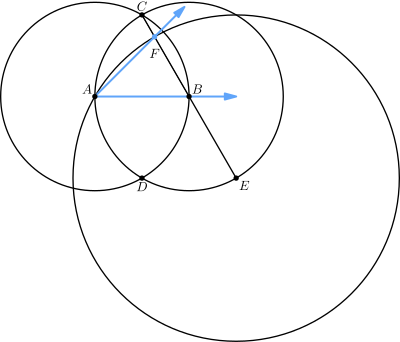
Beautiful, but also slightly mysterious!
The Explanation
Now check out this explanation from the wiki:
Understanding the alternate 5E solution is a bit more interesting, particularly since it does not directly produce any angles until the 2V solution, where Thales’ theorem states that and are perpendicular because they inscribe the diameter of circle . But determining that and form a angle from ray takes more thought. Note that both and are each a rhombus by construction from two equilateral triangles, with , and . Circle is created using the length of the longer diagonal of that rhombus, , which is . The length of is thus . Now consider point placed on as the base of the altitude of - the sub-triangle on the right, , is a -- triangle, so the length of is , and the length of is . But we also know . Thus, since , is a right isosceles triangle, and we have proven that .
I’m honestly not sure how you could write this up in good faith. While probably correct, alarm bells should be ringing: “This can’t be the best way to show that angle is !” Do we really need auxiliary points, rhombuses, side length computations, arithmetic, similar triangles, AND angle chasing? Of course not. But most importantly, this explanation completely obscures the actual motivation behind discovering the solution.
The ACTUAL Explanation
Connect and consider :
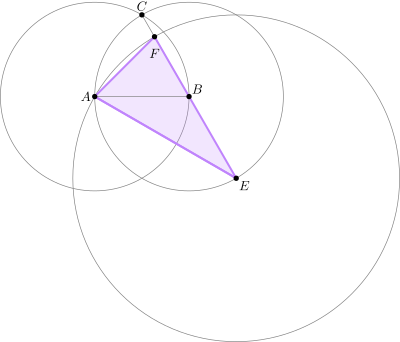
We know three things about this triangle:
- and are both radii of circle , so the triangle is isosceles.
- and are both radii of circle .
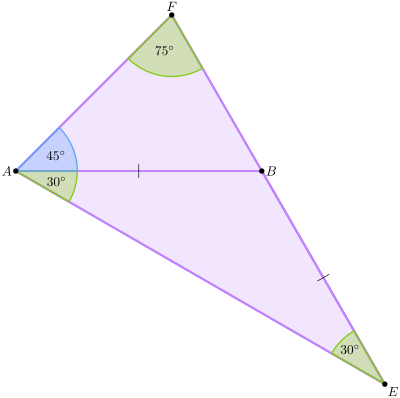
- since is a -- triangle. Why? (from the equilateral triangle), and because it inscribes diameter .
by itself is just:
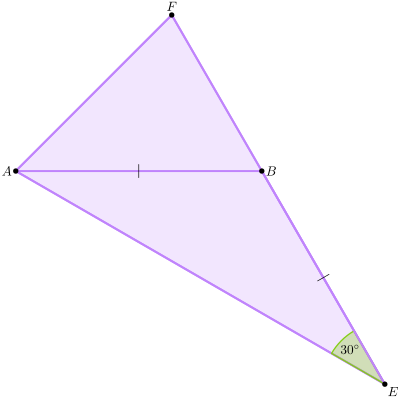
Angle chase this triangle and watch the fog lift, revealing the construction in its elegant simplicity: